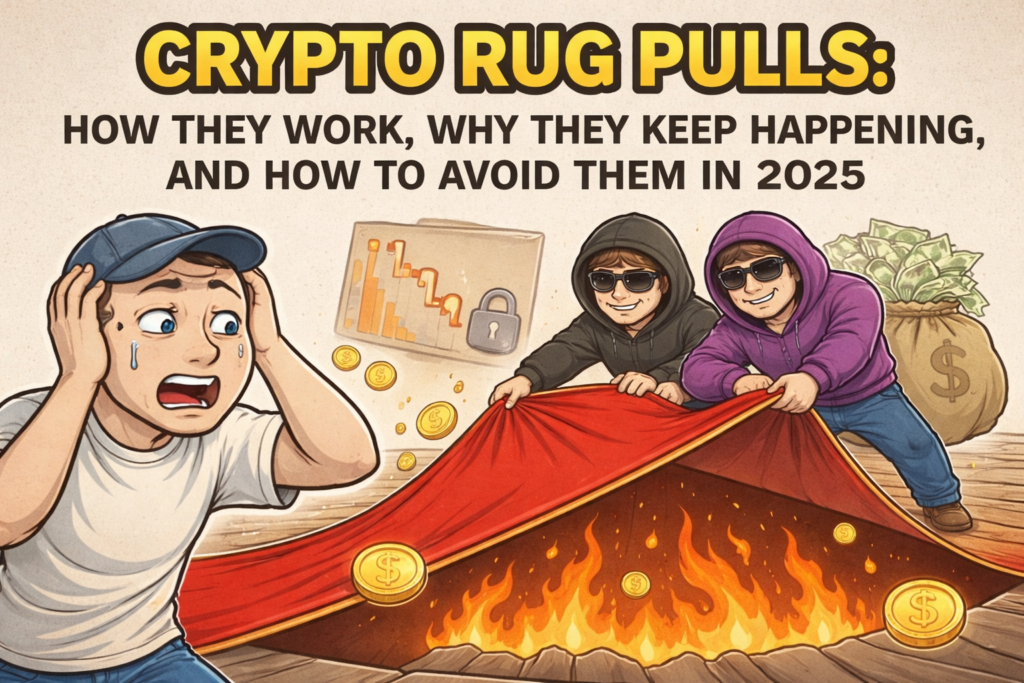
Crypto rug pulls didn’t disappear after the last market cycle.
They didn’t slow down when platforms promised “fair launches.”
And they didn’t magically stop when people became more educated.
In fact, these rug pull schemes have evolved.
Modern scams of this kind are faster, more psychological, and more deceptive than ever — especially in high-velocity ecosystems like Solana and pump.fun, where speed is rewarded and caution is punished.
If you’ve been in crypto long enough, you’ve either:
- been rugged,
- watched someone else fall victim,
- or unknowingly benefited from someone else becoming exit liquidity.
This article isn’t here to scare you out of crypto.
It’s here to explain how rug pulls actually work, why even legitimate projects can be targeted, and how to protect yourself without becoming cynical or paranoid.
Most importantly, it explains why structural transparency — not promises — is the only real defense.
What a Rug Pull Actually Is (Beyond the Meme Definition)
At a basic level, a rug pull looks like this:
- attention builds,
- price rises,
- confidence grows,
- liquidity or supply exits,
- late participants are left holding losses.
But that explanation misses the most important part.
These events are not just technical failures — they are psychological operations.
The code enables the exit.
The story makes it work.
They exploit:
- optimism,
- fear of missing out,
- social proof,
- authority signals,
- incomplete information,
- and human impatience.
Coinbase has repeatedly shown that most crypto scams succeed not through complex exploits, but through social engineering and narrative manipulation:
https://www.coinbase.com/learn/tips-and-tutorials/what-is-a-rug-pull-and-how-to-avoid-it
Why These Schemes Keep Working (Even on “Educated” Users)
Rug-style scams persist because they rely on permanent features of human behavior, not ignorance.
1. Asymmetric Information
Some participants always know more:
- deployers,
- early wallet clusters,
- coordinated groups,
- experienced manipulators.
Most retail participants arrive later, with less context.
2. Speed Beats Reflection
In ecosystems like Solana:
- tokens launch constantly,
- charts move in minutes,
- hesitation means missing the trade.
This environment rewards decisiveness — and punishes due diligence.
3. The Greater Fool Theory (The Part Most Projects Won’t Acknowledge)
The greater fool theory states:
An asset doesn’t need intrinsic value — it only needs someone else willing to pay more for it later.
This theory underpins much of speculative crypto and explains why these scams remain effective.
Reuters has documented how speculative token markets detach from fundamentals during hype cycles — a condition where these schemes thrive:
https://www.reuters.com/technology/cryptoverse-nft-bubble-gets-that-shrinking-feeling-2022-04-05/
Backer is unusually transparent about this reality:
We want real people participating — not whales, not insiders, and definitely not ruggers.
But crypto is adversarial by nature, and pretending otherwise only helps bad actors.
That transparency is documented publicly:
https://backertoken.tech/transparency-page/
The Uncomfortable Truth: Legitimate Projects Can Still Be Exploited
Not every incident begins with malicious developers.
In many cases:
- the project is real,
- the intent is genuine,
- the structure is exposed.
This is especially common in fast-launch environments like pump.fun, where these tactics are amplified by speed and misinformation.
Experienced actors:
- identify underprotected launches,
- accumulate early supply,
- manufacture momentum,
- then exit into uninformed buyers.
From the outside, it looks identical to a dev-driven rug.
From the inside, it’s a structural failure.
A Real Example: Weaponized Misinformation and Chart Manipulation
This isn’t theoretical — it’s a real tactic used repeatedly in crypto markets.
In Backer’s case, one coordinated group falsely claimed that the Backer developer was an ex-Solana developer.
This claim was:
- immediately denied,
- publicly corrected,
- and transparently addressed.
There is no ex-Solana affiliation.
That narrative is untrue.
Despite this, the group continued repeating it while engineering a chart that appeared to signal insider momentum — a classic manipulation tactic aimed at people who:
- don’t know the context,
- don’t verify claims,
- and assume price action equals legitimacy.
This mirrors well-documented pump-and-dump behavior:
https://www.investopedia.com/terms/p/pumpanddump.asp
Backer chose the harder route:
- deny the claim clearly,
- avoid reinforcing it,
- and let documentation speak for itself.
That documentation lives publicly in the Backer whitepaper:
https://backertoken.tech/whitepaper/
How Scammers and Manipulators Actually Operate
These schemes rarely begin with theft.
They begin with over-giving.
Common behaviors include:
- promising extraordinary upside,
- vague or infinite roadmaps,
- manufactured urgency,
- reframing skepticism as “FUD,”
- constant requests for deeper commitment.
The SEC consistently warns that exaggerated or guaranteed returns are a hallmark of crypto scams:
https://www.sec.gov/investor/alerts/scam-alerts
Quality builders behave differently:
- they explain constraints,
- acknowledge risk,
- document mechanics,
- and prioritize understanding over belief.
Crypto Psyops: The Layer That Powers Many of These Scams
Crypto markets aren’t just code and price — they’re psychological warfare at scale.
Common tactics include:
- coordinated influencer timing,
- fake grassroots enthusiasm,
- manufactured opposition,
- narrative flipping,
- false authority claims.
Many collapses happen when the story breaks, not the contract.
Why Most Anti-Scam Advice Falls Short
Checklist advice helps, but it’s incomplete.
Most failures rely on:
- many small ambiguities,
- plausible deniability,
- and time pressure.
The real questions are structural:
- Who benefits if this fails?
- Who controls exits?
- Who absorbs downside?
- What happens when momentum stops?
If those answers aren’t visible, risk remains hidden.
What Responsible Projects Do Differently
Projects that survive long-term share common traits:
- transparent token distribution,
- explicit acknowledgment of speculation,
- defensive design against concentration,
- separation between funding and promises.
Backer follows this model by design, not marketing:
https://backertoken.tech/whitepaper/
Participation happens through a visible application environment, not private allocations:
https://app.backertoken.tech/
Why Backer Is Open About the Greater Fool Theory
Most projects quietly rely on speculation while denying it publicly.
Backer does the opposite — openly acknowledging the forces at play so participants can make informed decisions.
Transparency here is a constraint, not a promise.
How to Protect Yourself Going Forward
You can’t eliminate risk.
You can choose it consciously.
Ask:
- Is failure discussed?
- Are incentives clear beyond price?
- Is understanding encouraged?
- Would this still make sense without momentum?
Scams thrive where questions are discouraged.
Final Thought
Rug-style crypto scams are not anomalies.
They are the predictable outcome of:
- speed,
- speculation,
- psychology,
- and asymmetric information.
The future belongs to projects that:
- understand this reality,
- design honestly within it,
- and treat participants like adults — not marks.
Backer exists because ignoring these dynamics is no longer acceptable.
Not because it promises protection —
but because it refuses to lie about the game being playe